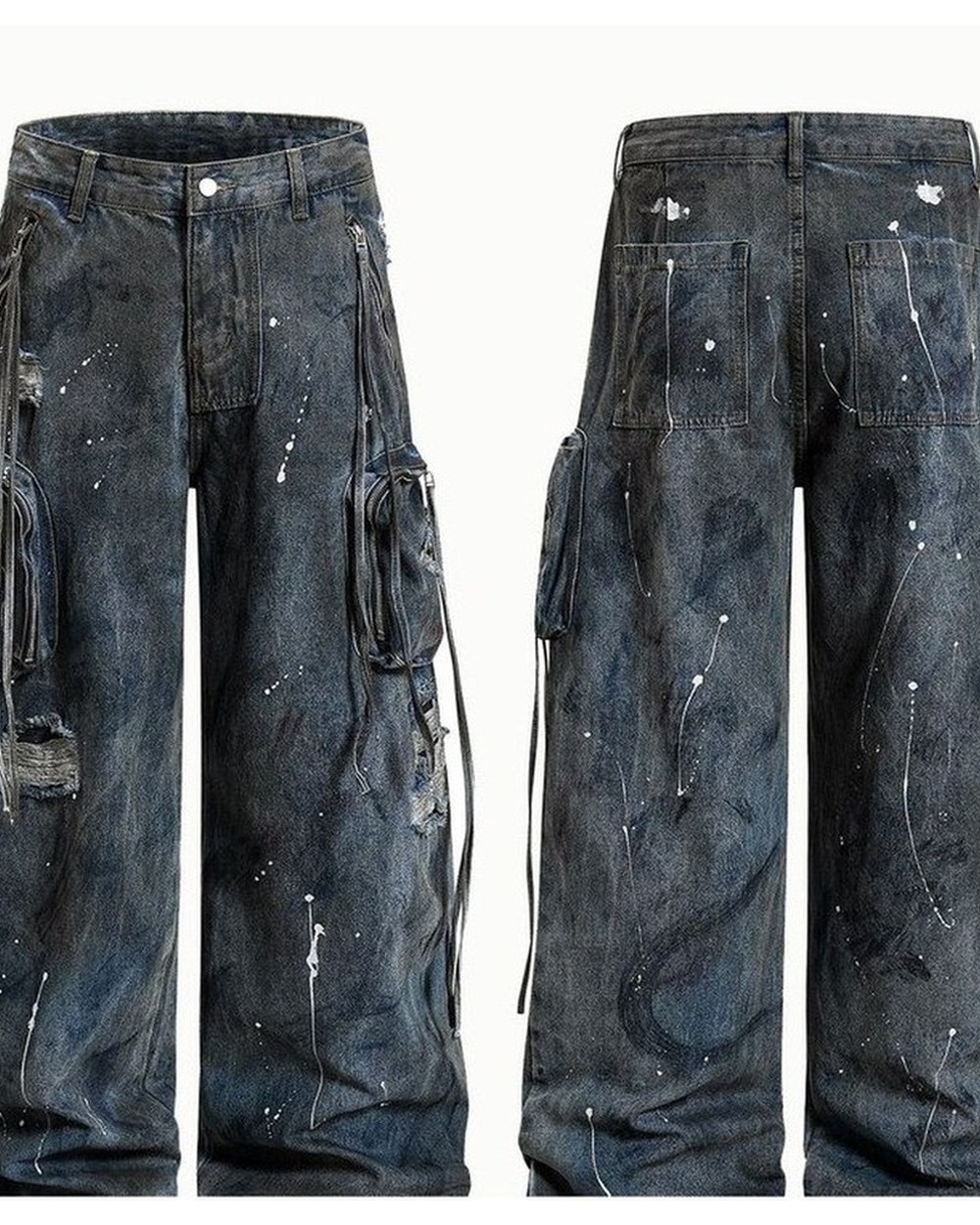
A denim tech pack is a short document full of words that mean something precise to the person cutting the fabric and something vague to the person writing the order. This glossary defines 13 of those terms the way we use them in the factory, with the numbers attached, so a buyer and a pattern maker can agree on what is being approved.
Denim weight: what an ounce actually measures
Denim weight is ounces per square yard, not ounces per garment. One ounce per square yard is about 33.9 grams per square meter, so a 12 oz denim is roughly 407 g/m², a 10.5 oz stretch is about 356 g/m² and a 14.5 oz rigid is about 492 g/m². Buying by the meter without knowing the width and the weight is how a quote ends up 30% off.
Weight also moves after washing. A greige 12 oz can finish at about 11.2 oz after an enzyme wash, because the drum relaxes the cloth and abrades the surface. Always quote the finished weight, and state whether the number refers to greige or washed fabric. The four bands we work in:
- 9–11 oz: stretch denim, shirts, kids' jeans and summer shorts.
- 12–13.5 oz: the working range for five-pocket jeans.
- 14–14.5 oz: workwear and raw denim, which needs a heavier needle and seam spec.
- Loom state: add 6–10% shrinkage in the warp if the fabric is unsanforized.
Selvedge, loom state and rope dyeing
Selvedge is the self-finished edge produced on a shuttle loom. Because the shuttle carries one continuous weft, the edge does not fray, and the outseam can be left unsewn or finished with a simple double stitch. The looms are narrow — 28 to 32 inches — so a marker wastes more fabric than on a 58 inch roll, and that waste is part of why selvedge costs more per pair.
Loom state, or greige, means the fabric has not been washed or sanforized since it left the loom. It shrinks 6–10% in the warp on the first wash, which is either the point of the product or a defect, depending on what you told your customer. If you sell raw denim, say so in the care label; if you sell a jean that must fit on delivery, you do not want loom state.
Rope dyeing bundles 300 to 400 yarn ends into a rope, dips the rope in indigo vats 6 to 8 times, and sizes it before weaving. The indigo coats the outside of the yarn and leaves a white core, which is why a rope-dyed jean fades to a clear blue rather than going grey at the knee. Slasher dyeing, the cheaper route, dyes a flat sheet of yarns and gives a flatter fade.
Sanforizing: the number behind your shrinkage spec
Sanforizing passes damp fabric through a rubber belt and a heated cylinder that compresses the warp before it can relax back. Residual shrinkage drops from 6–10% to about 1–2%, which is the difference between a size 32 that stays a 32 and one that arrives a size small after the first wash.
The spec line should read something like sanforized to 2% residual, tested with 3 home washes at 40°C. If a supplier quotes only the word sanforized, ask for the residual figure and the test method. A fabric can be sanforized and still shrink 4% if the mill ran the line fast.
Twill direction and why it changes the leg
Denim is a twill, which means the warp yarns float over two or three weft yarns in a diagonal line. A 3/1 right-hand twill is the default for jeans: the diagonal runs up to the right on the face of the cloth. Left-hand twill runs the other way, drapes slightly differently and twists the leg in the opposite direction after washing.
Leg twist is real and should be in the tolerance. A right-hand twill leg can rotate 1–2 cm at the hem after a stone wash, and if your fit model photographs the jean from the side, that rotation is visible. State the twill direction and the acceptable twist in the tech pack, and check both on the wash sample rather than the greige sample.
Whiskering, garment dye, resin and laser
Whiskering is the faded crease pattern that radiates across the hip from the crotch and fly. It can be produced by hand sanding, by laser, or by a mould and resin. Placement matters more than depth: a whisker pattern shifted 2 cm reads as a different jean, so put the placement on the tech pack as a marked-up photograph, not a verbal description.
Garment dye means the sewn jean goes into the dye bath, rather than the yarn being dyed before weaving. It gives a soft, slightly uneven color and 2–5% shrinkage, and it demands dye-compatible thread and trims — a polyester thread stays white while the cotton body takes the color. Resin is a polymer coating sprayed or dipped and cured at about 150–160°C; it sets 3D creases and stiffness, and it is what makes a dry, crunchy hand-feel that softens with wear.
Laser finishing burns indigo off the surface following a digital file. It is repeatable to the millimetre, it replaces hand sanding on whiskers and chevrons, and it is the only way to run the same fade on 3,000 pcs without a drift between operators. The trade-off is a flatter, more graphic look than hand work, which is why vintage washes still use sanding alongside it.
Laundry PPM: the figure that sets your wash cost
In our laundry, PPM means pieces per machine per cycle: how many garments go into one drum. A 12 oz rigid jean runs 300 to 600 pcs per drum depending on the recipe, and the figure falls as the wash gets more complex, because hand work and drying time queue behind the drum.
PPM is why a 300 pc order costs more per unit to wash than a 3,000 pc order. The drum, the water and the operator hour are the same whether it holds 300 or 600 pieces, so the per-unit cost at the low end of the MOQ is roughly double. Ask for PPM and cycle time in hours before you compare wash prices between factories.
POM and grade rules: the two files that decide fit
POM stands for point of measure. A measurement chart lists each POM — waist flat, hip, front rise, back rise, thigh, knee, leg opening, inseam — with a target and a tolerance. Our standard tolerance is ±0.6 cm on the waist and ±0.7 cm on the inseam, tighter than the ±1 cm many buyers write, because a waistband is cut from a straight strip and has no reason to wander.
A grade rule is the increment added or subtracted between sizes. On a men's 28–46 waist we grade 2.5 cm at the waist and 2 cm at the hip per size, and hold the inseam constant; kids' sizes grade by height band, roughly 6 cm, with a different rise increment. Copying an adult grade rule into a kids' or plus-size range is the single most common fit failure we see.
- Ask for the POM list before the sample, not after.
- Approve the grade rule on paper, then on a sample in the middle size.
- Keep the signed chart with the pattern file; the reorder depends on it.
Using the glossary on a real order
Put the terms in one line per attribute and the arguments disappear. This is a complete fabric and construction line for a mid-weight jean: 12 oz rigid, 3/1 right-hand twill, rope-dyed indigo, sanforized to 2% residual, 7.5 oz after wash, laser whiskers with hand sanding on the chevron, 3D resin on the hip. A pattern maker can quote that without asking a single question, and a buyer can reject a bulk lot against it.
If you want the longer version of any term here, the fabric weights guide covers the numbers behind the bands, and the wash guide explains what each of the 12 stock recipes does to the cloth. Both are written against live orders, so the figures match what we quote.
Next step
Send your tech pack, even a rough one, and we will mark the terms that are ambiguous, propose the fabric weight that fits your price and confirm what the wash will add in days and dollars. A glossary is useful; a signed measurement chart is what actually protects the order. Start with a conversation with our merchandising team.